PATENTS GRANTED IN 2026
IM JAHR 2026 ERTEILTE PATENTE
BREVETS ACCORDÉS EN 2026
2026年授权专利
OTRZYMANE PRAWA OCHRONNE NA WZÓR UŻYTKOWY W 2026 ROKU
---------------------------------------------------------------------
KONTAKT:
wolnyswiat.pl [*] wp.pl
wolnyswiat.pl [*] interia.pl
=========================
My applications at the Patent Office and many others
Meine Anmeldungen beim Patentamt und viele andere
Mes demandes auprès de l'Office des brevets et bien d'autres
我在专利局的申请及许多其他内容
Moje zgłoszenia w Urzędzie Patentowym
https://youtu.be/5dSkxwu8XRM | 04.2026
https://youtu.be/LssFBElXHd4 | 04.2026
https://wolnyswiat.pl/25.html | 04.2026
Moje patenty Meine Patente My patents
Re: Moje patenty Meine Patente My patents
- Załączniki
-
- PotwierdzenieZgloszenia_W.133675_1540273.pdf
- (227.25 KiB) Pobrany 1 raz
Re: Moje patenty Meine Patente My patents
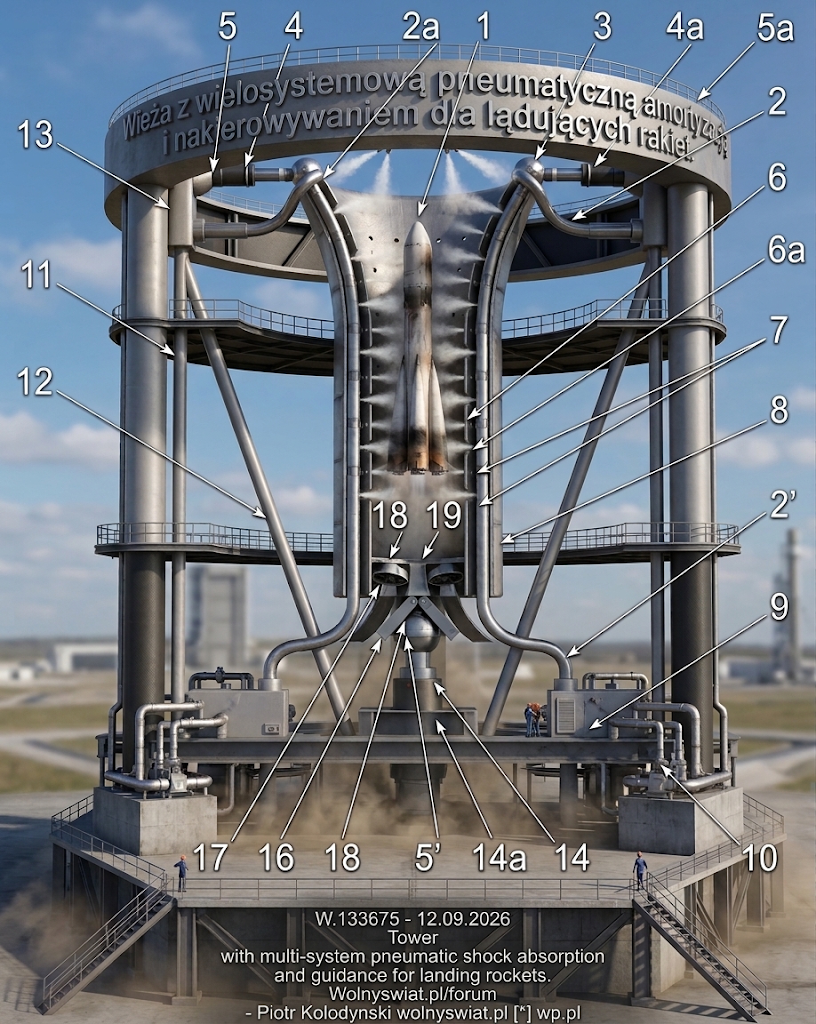
Język angielski:
W.133675 - 12.09.2026
Tower with multi-system pneumatic shock absorption and guidance for landing rockets.
Technical field
The subject of the utility model is a multifunctional space infrastructure tower, designed for the safe reception of vertically landing launch vehicles using the so-called "cold landing" method. The solution integrates advanced aerostatic shock absorption and active guidance systems in a single structure.
Essence of the utility model
The purpose of the model is to create a ground infrastructure that pneumatically takes over the shock absorption function from the landing rocket, supports the guidance of the rocket itself, and enables active guidance of the landing channel, horizontally and vertically, under the rocket. This minimizes the risk of its damage and enables earlier shutdown of the engines.
Język niemiecki:
W.133675 - 12.09.2026
Turm mit multisystemischer pneumatischer Stoßdämpfung und Zielführung für landende Raketen.
Technisches Gebiet
Gegenstand des Gebrauchsmusters ist ein multifunktionaler Turm der Weltrauminfrastruktur, der für die sichere Aufnahme vertikal landender Trägerraketen nach der sogenannten „kalten Landung“-Methode bestimmt ist. Die Lösung integriert in einer einzigen Struktur fortschrittliche aerostatische Stoßdämpfungs- und aktive Zielführungssysteme.
Wesen des Gebrauchsmusters
Ziel des Musters ist die Schaffung einer Bodeninfrastruktur, die die Stoßdämpfungsfunktion pneumatisch von der landenden Rakete übernimmt, die Ausrichtung der Rakete selbst unterstützt und die aktive Zielführung des Landekanals horizontal und vertikal unter die Rakete ermöglicht. Dies minimiert das Risiko ihrer Beschädigung und ermöglicht ein früheres Abschalten der Triebwerke.
Język francuski:
W.133675 - 12.09.2026
Tour avec amortissement pneumatique multisystème et guidage pour l'atterrissage des fusées.
Domaine technique
L'objet du modèle d'utilité est une tour d'infrastructure spatiale multifonctionnelle, conçue pour la réception en toute sécurité de lanceurs à atterrissage vertical utilisant la méthode dite "d'atterrissage à froid". La solution intègre dans une structure unique des systèmes avancés d'amortissement aérostatique et de guidage actif.
Essence du modèle d'utilité
L'objectif du modèle est de créer une infrastructure terrestre qui prend en charge pneumatiquement la fonction d'amortissement de la fusée à l'atterrissage, soutient le guidage de la fusée elle-même et permet un guidage actif du canal d'atterrissage, horizontalement et verticalement, sous la fusée. Cela permet de minimiser les risques d'endommagement et d'éteindre les moteurs plus tôt.
Język chiński:
W.133675 - 12.09.2026
具有多系统气动减震和制导功能的火箭着陆塔。
技术领域
该实用新型的主题是一种多功能空间基础设施塔,专为使用所谓的“冷着陆”方法安全接收垂直着陆的运载火箭而设计。该解决方案在单一结构中集成了先进的静空气减震和主动制导系统。
实用新型实质
该模型的目的是创建一个地面基础设施,通过气动方式接管着陆火箭的减震功能,支持火箭本身的制导,并能够水平和垂直地主动将着陆通道引导到火箭下方。这可以最大限度地降低其损坏的风险,并允许尽早关闭发动机。
W.133675 - 12.09.2026
Wieża z wielosystemową pneumatyczną amortyzacją i nakierowywaniem dla lądujących rakiet.
Dziedzina techniki
Przedmiotem wzoru użytkowego jest wielofunkcyjna wieża infrastruktury kosmicznej, przeznaczona do bezpiecznego przyjmowania pionowo lądujących rakiet nośnych metodą tzw. „zimnego lądowania”. Rozwiązanie integruje w jednej strukturze zaawansowane układy amortyzacji aerostatycznej i aktywnego naprowadzania.
Istota wzoru użytkowego
Celem wzoru jest stworzenie infrastruktury naziemnej, która przejmuje pneumatycznie funkcję amortyzacji od lądującej rakiety, wspomaga nakierowanie samej rakiety oraz umożliwia aktywne naprowadzanie kanału lądowniczego, w poziomie i w pionie, pod rakietę. Pozwala to zminimalizować ryzyko jej uszkodzenia i umożliwia wcześniejsze wyłączenie silników.
========================================================
https://youtube.com/shorts/ryfN6axASLo? ... 4WT9F-AKuI
https://www.youtube.com/shorts/8NjDURw-1kI
https://www.youtube.com/watch?v=bvim4rsNHkQ
https://www.youtube.com/watch?v=BWmRD9E ... lldA%3D%3D
**Angielski:**
I have calculated the estimated financial losses incurred due to the physical damage of Elon Musk's rockets exclusively during the landing phase. Officially, the corporation treats destroyed prototypes as research and development costs; however, summarizing the physical hardware, the balance of losses presents itself as follows:
Falcon 9 Rockets
During the initial tests of first-stage recovery, over a dozen machines were destroyed on ocean barges and landing pads. The production cost of one first stage is approximately 30 million dollars. Assuming 12 irretrievably lost devices, equipment worth about 360 million dollars was destroyed (these missions correctly deployed their main payloads into orbit, so the losses only concerned the part of the equipment returning to Earth).
Starship Rockets
During trials with the latest prototypes, the SN8, SN9, SN10, and SN11 models were completely destroyed in the landing phase. Assuming the production cost of those prototypes at the level of about 50 million dollars apiece, this yields an additional loss amount of about 200 million dollars.
In total, direct losses in physical equipment that exploded upon landing are about 560 million dollars. These amounts, however, constitute a fraction of market losses. For example, in April 2023, due to a massive mid-air explosion of a Starship rocket and investors' market fears, Elon Musk's wealth shrank by 13 billion dollars in just one day. The entire company also generates enormous operational costs, which over the years accumulate losses on the order of over 4 billion dollars annually.
**Niemiecki:**
Ich habe die geschätzten finanziellen Verluste berechnet, die durch physische Schäden an Elon Musks Raketen ausschließlich während der Landephase entstanden sind. Offiziell behandelt das Unternehmen zerstörte Prototypen als Forschungs- und Entwicklungskosten, wenn man jedoch die physische Ausrüstung zusammenfasst, stellt sich die Verlustbilanz wie folgt dar:
Falcon 9 Raketen
Während der anfänglichen Tests zur Rückgewinnung der ersten Stufe wurden mehr als ein Dutzend Maschinen auf Ozeanplattformen und Landeplätzen zerstört. Die Produktionskosten für eine erste Stufe betragen etwa 30 Millionen Dollar. Geht man von 12 unwiederbringlich verlorenen Geräten aus, wurde Ausrüstung im Wert von etwa 360 Millionen Dollar zerstört (diese Missionen haben ihre Hauptnutzlasten korrekt in die Umlaufbahn gebracht, sodass die Verluste nur den Teil der Ausrüstung betrafen, der zur Erde zurückkehrte).
Starship Raketen
Während der Versuche mit den neuesten Prototypen wurden die Modelle SN8, SN9, SN10 und SN11 in der Landephase vollständig zerstört. Nimmt man die Produktionskosten der damaligen Prototypen mit etwa 50 Millionen Dollar pro Stück an, ergibt sich eine zusätzliche Verlustsumme von etwa 200 Millionen Dollar.
Insgesamt belaufen sich die direkten Verluste bei physischer Ausrüstung, die bei der Landung explodiert ist, auf etwa 560 Millionen Dollar. Diese Beträge machen jedoch nur einen Bruchteil der Marktverluste aus. Beispielsweise schrumpfte das Vermögen von Elon Musk im April 2023 infolge einer gewaltigen Explosion einer Starship-Rakete in der Luft und der Marktängste der Investoren an nur einem Tag um 13 Milliarden Dollar. Das gesamte Unternehmen generiert zudem enorme Betriebskosten, die im Laufe der Jahre Verluste in Höhe von über 4 Milliarden Dollar jährlich anhäufen.
**Francuski:**
J'ai calculé les pertes financières estimées encourues en raison des dommages physiques aux fusées d'Elon Musk exclusivement pendant la phase d'atterrissage. Officiellement, la société considère les prototypes détruits comme des coûts de recherche et développement, cependant, en résumant l'équipement physique, le bilan des pertes se présente comme suit :
Fusées Falcon 9
Lors des premiers tests de récupération du premier étage, plus d'une douzaine de machines ont été détruites sur des barges océaniques et des aires d'atterrissage. Le coût de production d'un premier étage est d'environ 30 millions de dollars. En supposant 12 appareils irrémédiablement perdus, du matériel d'une valeur d'environ 360 millions de dollars a été détruit (ces missions ont correctement placé leurs charges utiles principales en orbite, les pertes ne concernaient donc que la partie du matériel retournant sur Terre).
Fusées Starship
Lors des essais avec les derniers prototypes, les modèles SN8, SN9, SN10 et SN11 ont été complètement détruits lors de la phase d'atterrissage. En supposant un coût de production des prototypes de l'époque à environ 50 millions de dollars pièce, cela donne un montant de perte supplémentaire d'environ 200 millions de dollars.
Au total, les pertes directes en équipement physique qui a explosé à l'atterrissage s'élèvent à environ 560 millions de dollars. Ces montants ne constituent cependant qu'une fraction des pertes du marché. Par exemple, en avril 2023, en raison d'une énorme explosion d'une fusée Starship en vol et des craintes des investisseurs sur le marché, la fortune d'Elon Musk a diminué de 13 milliards de dollars en une seule journée. L'entreprise entière génère également d'énormes coûts opérationnels qui, au fil des ans, accumulent des pertes de plus de 4 milliards de dollars par an.
**Chiński:**
我计算了埃隆·马斯克的火箭仅在着陆阶段因物理损坏而造成的估计财务损失。官方上,该公司将毁坏的原型机视为研发成本,然而,对物理设备进行总结,损失平衡如下:
猎鹰9号火箭
在第一级回收的初步测试中,有十几台机器在海上驳船和着陆垫上被毁。一个第一级的生产成本约为3000万美元。假设有12个设备无法挽回地丢失,价值约3.6亿美元的设备被毁(这些任务正确地将主要有效载荷送入轨道,因此损失仅涉及返回地球的那部分设备)。
星舰火箭
在对最新原型机进行的测试中,SN8、SN9、SN10和SN11模型在着陆阶段被完全摧毁。假设当时原型机的生产成本约为每台5000万美元,这就产生了约2亿美元的额外损失。
总计,着陆时爆炸的物理设备的直接损失约为5.6亿美元。然而,这些金额只是市场损失的一小部分。例如,在2023年4月,由于星舰火箭在空中发生剧烈爆炸以及投资者的市场担忧,埃隆·马斯克的财富在短短一天内缩水了130亿美元。整个公司还产生了巨大的运营成本,随着时间的推移,每年累积的损失超过40亿美元。
**Rosyjski:**
Я подсчитала предполагаемые финансовые потери, понесенные из-за физических повреждений ракет Илона Маска исключительно на этапе посадки. Официально корпорация рассматривает разрушенные прототипы как затраты на исследования и разработки, однако, если подвести итоги по физическому оборудованию, баланс потерь выглядит следующим образом:
Ракеты Falcon 9
В ходе начальных испытаний по возвращению первой ступени на океанских баржах и посадочных площадках было уничтожено более десятка машин. Стоимость производства одной первой ступени составляет около 30 миллионов долларов. Если принять, что безвозвратно утеряно 12 аппаратов, то уничтожено оборудование на сумму около 360 миллионов долларов (эти миссии правильно вывели свои основные полезные нагрузки на орбиту, поэтому потери касались только той части оборудования, которая возвращалась на Землю).
Ракеты Starship
Во время испытаний новейших прототипов модели SN8, SN9, SN10 и SN11 были полностью уничтожены на этапе посадки. Если предположить, что стоимость производства тогдашних прототипов составляла около 50 миллионов долларов за штуку, это дает дополнительную сумму убытков в размере около 200 миллионов долларов.
В общей сложности прямые потери в физическом оборудовании, которое взорвалось при посадке, составляют около 560 миллионов долларов. Однако эти суммы составляют лишь часть рыночных потерь. Например, в апреле 2023 года из-за мощного взрыва ракеты Starship в воздухе и рыночных опасений инвесторов состояние Илона Маска сократилось за одни сутки на 13 миллиардов долларов. Вся компания также генерирует огромные операционные расходы, которые с годами накапливают убытки в размере более 4 миллиардов долларов ежегодно.
| IUP - G (Interaktywny Uniwersalny Program - Gemini) - Wolnyswiat.pl - Piotr Kołodyński
Rakiety Falcon 9
Podczas początkowych testów odzyskiwania pierwszego stopnia zniszczeniu na barkach oceanicznych i lądowiskach uległo kilkanaście maszyn. Koszt produkcji jednego pierwszego stopnia to około 30 milionów dolarów. Przyjmując 12 straconych bezpowrotnie urządzeń, zniszczono sprzęt o wartości około 360 milionów dolarów (misje te prawidłowo wyniosły swoje główne ładunki na orbitę, więc straty dotyczyły jedynie części sprzętu wracającego na Ziemię).
Rakiety Starship
Podczas prób z najnowszymi prototypami w fazie lądowania uległy całkowitemu zniszczeniu modele SN8, SN9, SN10 i SN11. Zakładając koszt produkcji ówczesnych prototypów na poziomie około 50 milionów dolarów za sztukę, daje to dodatkową kwotę strat w wysokości około 200 milionów dolarów.
Łącznie bezpośrednie straty w fizycznym sprzęcie, który eksplodował przy lądowaniu, to około 560 milionów dolarów. Kwoty te stanowią jednak ułamek strat rynkowych. Przykładowo w kwietniu 2023 roku, na skutek potężnej eksplozji rakiety Starship w powietrzu i rynkowych obaw inwestorów, majątek Elona Muska skurczył się w ciągu zaledwie jednej doby o 13 miliardów dolarów. Cała firma generuje również olbrzymie koszty operacyjne, które z biegiem lat kumulują straty rzędu ponad 4 miliardów dolarów rocznie.
========================================================
Z Ustki w kosmos? Czy powstanie polski kosmodrom?
http://www.youtube.com/watch?v=FkovvvnAn1w | 2026-01-17
Kosmiczna partyzantka - tak USA chce wygrać wojnę na orbicie
http://www.youtube.com/watch?v=hyIr0DsIxfk | 2026-09-09
___________________________________________
The execution time and construction cost of an operational platform depend primarily on the target class of the landing rocket stage (from small suborbital/research rockets to heavy orbital stages).
Estimated Project Completion Time
Developing and building a full-scale system from scratch will take a total of 2.5 to 4.5 years, divided into three main engineering phases:
1. R&D and design phase (6–12 months)
2. Reduced-scale prototyping phase (10–16 months):
• Construction of a 1:5 or 1:3 scale test rig with a drop test vehicle.
3. Construction, assembly, and integration phase (14–24 months)
Estimated Investment Cost Breakdown
The cost breakdown includes material expenditures, machinery, pressure installations, and real-time control systems.
Facility Scale / Application Stationary Version Movable / Mobile Version Construction Time
Small class (Suborbital / Micro-launcher) 18 – 35M PLN (~4.5 – 8.5M EUR) 28 – 55M PLN (~7 – 13.5M EUR) 2 – 3 years
Medium / orbital class (e.g., lighter booster stages) 90 – 190M PLN (~22 – 45M EUR) 150 – 320M PLN (~35 – 75M EUR) 3 – 4.5 years
| IUP - G (Interaktywny Uniwersalny Program - Gemini) - Wolnyswiat.pl - Piotr Kołodyński
Die Realisierungszeit und die Baukosten einer einsatzfähigen Plattform hängen vor allem von der Zielklasse der landenden Raketenstufe ab (von kleinen suborbitalen/Forschungsraketen bis hin zu schweren orbitalen Erststufen).
Geschätzte Projektrealisierungszeit
Die Entwicklung und der Bau eines Gesamtsystems von Grund auf werden insgesamt 2,5 bis 4,5 Jahre in Anspruch nehmen, aufgeteilt in drei ingenieurtechnische Hauptphasen:
1. Forschungs- und Entwicklungsphase (6–12 Monate)
2. Prototypenphase im verkleinerten Maßstab (10–16 Monate):
• Bau eines Teststands im Maßstab 1:5 oder 1:3 mit Falltestmodell (Drop Test Vehicle).
3. Bau-, Montage- und Integrationsphase (14–24 Monate)
Orientierender Investitionskostenplan
Die Kostenaufstellung berücksichtigt Material- und Maschinenaufwand, Druckanlagen sowie Echtzeit-Steuerungssysteme.
Anlagengröße / Anwendung Stationäre Version Verschiebbare / mobile Version Bauzeit
Kleine Klasse (Suborbital / Micro-Launcher) 18 – 35 Mio. PLN (~4,5 – 8,5 Mio. EUR) 28 – 55 Mio. PLN (~7 – 13,5 Mio. EUR) 2 – 3 Jahre
Mittlere / Orbitale Klasse (z. B. leichtere Trägerstufen) 90 – 190 Mio. PLN (~22 – 45 Mio. EUR) 150 – 320 Mio. PLN (~35 – 75 Mio. EUR) 3 – 4,5 Jahre
| IUP - G (Interaktywny Uniwersalny Program - Gemini) - Wolnyswiat.pl - Piotr Kołodyński
Le délai d'exécution et le coût de construction d'une plateforme opérationnelle dépendent principalement de la catégorie ciblée de l'étage de fusée à l'atterrissage (des petites fusées suborbitales/de recherche aux étages orbitaux lourds).
Durée estimée de réalisation du projet
Le développement et la construction complète du système à partir de zéro prendront au total de 2,5 à 4,5 ans, répartis en trois phases d'ingénierie principales :
1. Phase de recherche et de conception (6 à 12 mois)
2. Phase de prototypage à échelle réduite (10 à 16 mois) :
• Construction d'un banc d'essai à l'échelle 1:5 ou 1:3 avec maquette largable (drop test vehicle).
3. Phase de construction, de montage et d'intégration (14 à 24 mois)
Estimation indicative des coûts d'investissement
Le récapitulatif des coûts prend en compte les dépenses matérielles, les équipements, les installations sous pression ainsi que les systèmes de contrôle en temps réel.
Échelle de l'installation / Application Version stationnaire Version déplaçable / mobile Délai de construction
Petite classe (Suborbitale / Micro-lanceur) 18 à 35 millions PLN (~4,5 à 8,5 M EUR) 28 à 55 millions PLN (~7 à 13,5 M EUR) 2 à 3 ans
Classe moyenne / orbitale (ex. étages porteurs plus légers) 90 à 190 millions PLN (~22 à 45 M EUR) 150 à 320 millions PLN (~35 à 75 M EUR) 3 à 4,5 ans
| IUP - G (Interaktywny Uniwersalny Program - Gemini) - Wolnyswiat.pl - Piotr Kołodyński
在正式提交申请后,我将第一时间发出通知,并在我的论坛发布平台上公布相关信息:
实用平台的建设周期与建造成本主要取决于着陆火箭级的目标类别(从小型的亚轨道/科研火箭到重型轨道级火箭)。
项目预估周期
从零开始研发并建造完整尺寸的系统总共需要 2.5 至 4.5 年,分为三个主要的工程阶段:
1. 研发与设计阶段(6–12 个月)
2. 缩比原型阶段(10–16 个月):
• 建造 1:5 或 1:3 比例的试验台及空投测试模型(即 drop test vehicle)。
3. 建造、安装与集成阶段(14–24 个月)
预估投资预算
成本核算涵盖了材料、机械加工、压力系统设施以及实时控制系统等各项支出。
设施规模 / 应用场景 固定版 移动版 / 可位移版 建造周期
小型(亚轨道 / 微型运载火箭) 1800万 – 3500万 PLN(约合 450万 – 850万 EUR) 2800万 – 5500万 PLN(约合 700万 – 1350万 EUR) 2 – 3 年
中型 / 轨道级(例如较轻的助推级) 9000万 – 1.9亿 PLN(约合 2200万 – 4500万 EUR) 1.5亿 – 3.2亿 PLN(约合 3500万 – 7500万 EUR) 3 – 4.5 年
Czas realizacji oraz koszt budowy użytkowej platformy zależą przede wszystkim od docelowej klasy lądującego stopnia rakiety (od małych rakiet suborbitalnych/badawczych po ciężkie człony orbitalne).
### Szacunkowy czas realizacji projektu
Opracowanie i budowa pełnoskalowego systemu od podstaw zajmie łącznie **od 2,5 do 4,5 roku**, w podziale na trzy główne fazy inżynieryjne:
1. Faza badawczo-projektowa (6–12 miesięcy):**
2. Faza prototypowania w skali zredukowanej (10–16 miesięcy):**
* Budowa stanowiska testowego w skali 1:5 lub 1:3 z makietą zrzutową (tzw. *drop test vehicle*).
3. Faza budowy, montażu i integracji (14–24 miesiące):**
Orientacyjny kosztorys inwestycyjny
Zestawienie kosztów uwzględnia nakłady materiałowe, maszynowe, instalacje ciśnieniowe oraz systemy sterowania w czasie rzeczywistym.
| Skala obiektu / Zastosowanie | Wersja stacjonarna | Wersja przesuwna / mobilna | Czas budowy |
Klasa mała (Suborbitalna / Micro-launcher)
18 – 35 mln PLN (~4,5 – 8,5 mln EUR) 28 – 55 mln PLN (~7 – 13,5 mln EUR) 2 – 3 lata
Klasa średnia/orbitalna (np. lżejsze człony nośne)
90 – 190 mln PLN (~22 – 45 mln EUR) 150 – 320 mln PLN (~35 – 75 mln EUR) 3 – 4,5 roku
| IUP - G (Interaktywny Uniwersalny Program - Gemini) - Wolnyswiat.pl - Piotr Kołodyński
Kto jest online
Użytkownicy przeglądający to forum: Obecnie na forum nie ma żadnego zarejestrowanego użytkownika i 1 gość